 Paraswap
, now Velora, combines DEX aggregation and intent-based swaps on supported networks
Paraswap is now Velora, combining decentralized exchange routing with intent-based swaps across supported networks. DEX aggregation compares liquidity sources, while Delta lets settlement agents execute an authorized trading instruction. Crosschain availability follows the selected route. Gasless settlement can still require a paid token approval or native-token deposit before execution.
Paraswap announced the Velora name on April 3, 2025 as its scope expanded beyond DEX aggregation. Market and Delta describe different execution paths within the same protocol. Their funding requirements and delivery conditions explain which capabilities apply to a particular swap.
Swap Routing Across DEX Liquidity
Market routing connects a chosen input token to the desired output by comparing executable paths through liquidity available on the selected blockchain. A route can exchange tokens directly, use intermediary assets or divide execution across several liquidity sources. Intermediary assets can link the input and output when direct liquidity is limited, while splitting draws on several pools. The routing decision also considers execution costs. Additional hops can improve output while adding network gas, so comparing routes requires both estimates.
A Market quote contains an expected output and a gas estimate for its proposed route. The underlying liquidity can change before settlement. For a sell-side swap, slippage tolerance sets an execution boundary and the transaction checks the corresponding minimum output. This separates the estimate from the amount that the contract must deliver for execution to succeed. A quote describes a routing plan without committing liquidity to the trade.
Augustus Routing and Firm Quotes
Augustus v6.2 executes Market routes on-chain, while AugustusRFQ settles signed liquidity offers from market makers and direct counterparties. Augustus can carry a multi-hop route within a single atomic swap transaction. Atomic settlement means that the swap completes together or reverts if a required operation fails. This property lets applications compose a routed swap with another contract action. A route containing several exchanges therefore does not imply a separate wallet transaction for every exchange.
An RFQ, or request for quote, adds liquidity priced by market makers. The maker supplies a signed offer for on-chain settlement, subject to available inventory and valid spending permissions. AugustusRFQ also supports over-the-counter trades between counterparties with agreed terms, including partial fills where supported. Those bilateral offers differ from an open Delta limit order that the solver network can fulfill.
Independent auditors have reviewed Augustus v6.2. Critical protocol surfaces include emergency pause mechanisms, allowing intervention when contract behavior requires attention. A paused component cannot process its ordinary trades.
Delta Execution Through Portikus
Delta translates an authorized trading intention into an order that settlement agents compete to fulfill under its token, amount and execution conditions. An intent describes the desired exchange; agents determine how to supply an executable fill. Delta selects a winning fill from Portikus solvers through a private sealed-bid auction. Solvers submit offers without seeing one another’s bids, and settlement executes the winning fill through the Delta contract. The contract checks the order’s authorization before carrying out the exchange.
Private order competition reduces the public-mempool exposure that enables sandwich attacks around a swap. This protection concerns order execution before settlement. Solver participation and an executable offer remain necessary for fulfillment. Once accepted, an order’s identifier supports progress tracking; its status distinguishes pending execution from completed delivery.
An unsuccessful same-chain settlement reverts that fill’s token movement. Native-funded and crosschain orders add funding or delivery states that require separate treatment.
Gasless Settlement and Token Funding
Gasless Delta settlement means agents handle the swap’s execution gas, while the wallet may need to pay for a token authorization transaction beforehand. ERC-20 is the common fungible-token standard on EVM networks. These tokens use spending permissions that bind an allowance to a particular contract. Market uses the Augustus v6.2 spender; Delta uses its own contract. A sufficient existing allowance can remove the need for a fresh approval. Compatible immediate swaps can also use signed permits, subject to the token and integration supporting the chosen authorization method.
Selling native ETH through Delta uses dETH, Delta’s wrapped representation of deposited native funds at a 1:1 rate. A native-ETH Delta order requires an on-chain deposit when the owner lacks sufficient dETH funding. The deposit transaction both escrows ETH and authorizes the order. It therefore carries a network cost before agent settlement. A sufficient existing dETH balance can fund an order through the ordinary signature flow without another deposit. Native funding places the input in the protocol before execution; a standard ERC-20 order draws its input from the wallet at settlement.
Crosschain Delivery on Supported Networks
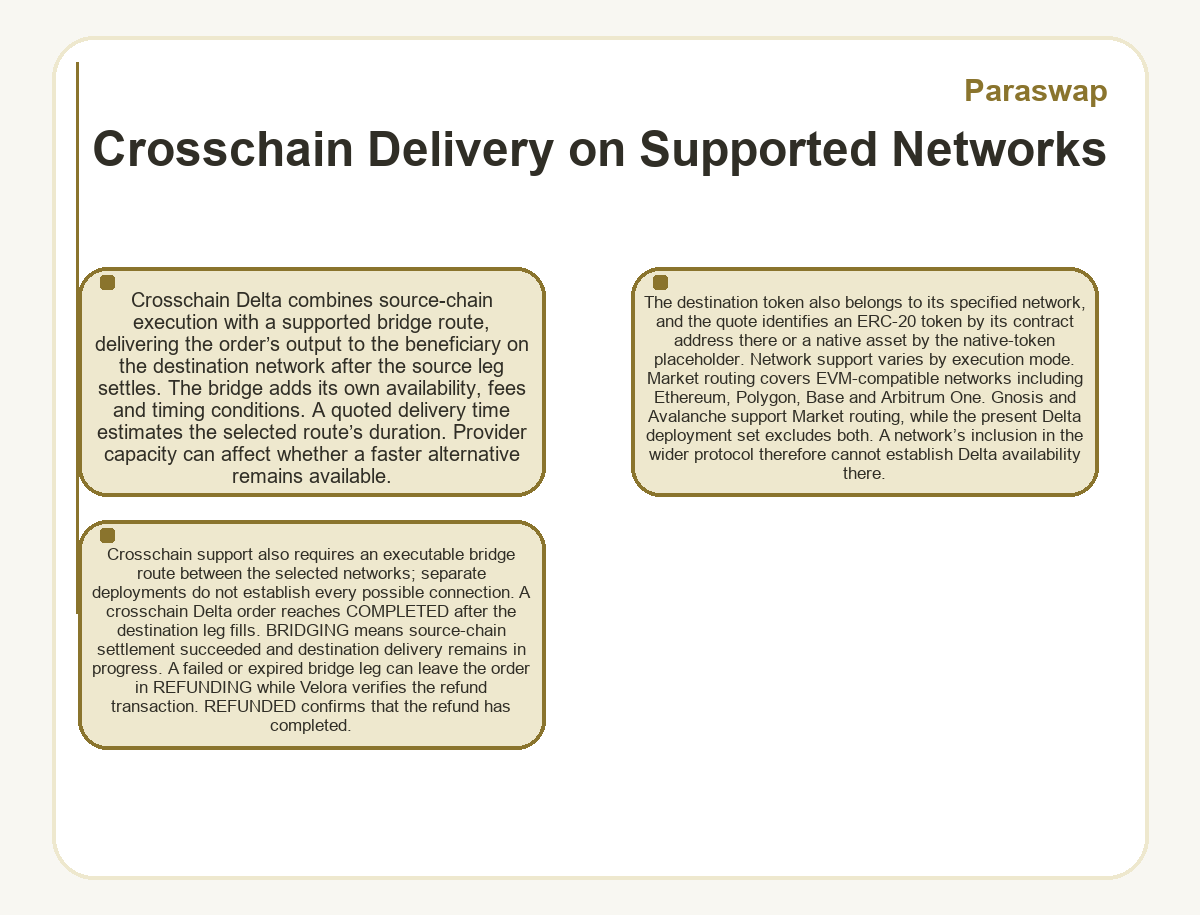
Crosschain Delta combines source-chain execution with a supported bridge route, delivering the order’s output to the beneficiary on the destination network after the source leg settles. The bridge adds its own availability, fees and timing conditions. A quoted delivery time estimates the selected route’s duration. Provider capacity can affect whether a faster alternative remains available. The destination token also belongs to its specified network, and the quote identifies an ERC-20 token by its contract address there or a native asset by the native-token placeholder.
Network support varies by execution mode. Market routing covers EVM-compatible networks including Ethereum, Polygon, Base and Arbitrum One. Gnosis and Avalanche support Market routing, while the present Delta deployment set excludes both. A network’s inclusion in the wider protocol therefore cannot establish Delta availability there. Crosschain support also requires an executable bridge route between the selected networks; separate deployments do not establish every possible connection.
A crosschain Delta order reaches COMPLETED after the destination leg fills. BRIDGING means source-chain settlement succeeded and destination delivery remains in progress. A failed or expired bridge leg can leave the order in REFUNDING while Velora verifies the refund transaction. REFUNDED confirms that the refund has completed.
What Determines the Cost of a Swap?
Swap costs reflect the chosen liquidity route, network execution, integration fees and any bridge leg that carries value between the supported chains. Market transactions require network gas from the submitting wallet. Additional hops and split execution can change both the token output and the gas needed for settlement. Delta handles settlement gas within its execution flow, while crosschain quotes also account for the selected bridge. Gas abstraction changes how execution costs reach the trade; the quoted output remains essential when comparing the available paths.
Integrations can charge a percentage fee or use surplus sharing. A configured percentage fee affects the quote, while surplus sharing concerns execution that improves on the quoted terms. The recipient of captured surplus follows the integration’s configuration. Different wallet integrations can therefore offer the same protocol with different fee terms. Changing the trade amount can also change which liquidity path is attractive, even when the token pair and network stay the same.
Choosing an Execution Path
Market and Delta fit different execution needs within Velora, especially when an application must combine a swap with another contract action or deliver assets across chains. Both modes can serve same-chain trading. Market’s atomic router call fits synchronous contract composition; Delta’s order architecture fits agent-mediated fulfillment and supported crosschain delivery. The distinction concerns how the exchange must execute, so a same-chain destination alone cannot choose the appropriate mode.
- Choose Market when the swap must settle inside the same transaction as another contract action.
- Consider Delta when a supported solver quote meets the trade’s required output and order conditions.
- Require an available bridge route when the destination lies on a different chain.
- Match the token authorization or native deposit to the execution mode that the quote actually returns.
- Assess the quoted output alongside separately paid network gas and any bridge costs, accounting for fees already included in the quote.
Limit Orders, Scheduled Trades and Super Hooks
Limit orders and time-weighted average price (TWAP) orders extend Delta with a price condition or trade schedule, using its solver and settlement infrastructure. A limit order can rest until a solver meets its price; its deadline ends the opportunity to fill. A sell TWAP fixes the total source amount and distributes execution across slices. A buy TWAP targets a total destination amount while capping the source budget. Each slice must satisfy the order’s constraints. These orders retain funding and authorization requirements throughout their relevant lifetime.
Super Hooks connect swaps and crosschain operations with other protocol actions, including collateral swaps in lending protocols and agent-managed liquidity operations. The additional action brings the connected protocol’s own requirements into the operation. An integration needs support for the selected hook and its connected protocols. The route must also support the underlying swap.
Wallet Access and Application Integrations
The Velora trading interface provides a wallet-facing entry point, while APIs and libraries let applications integrate routing, orders and settlement into their own products. Programmatic access includes a REST API, a TypeScript SDK and an embeddable trading widget. The API offers direct control over product requests and responses. The SDK supplies typed integration methods, and the widget supplies a trading interface that an application can embed.
An integration determines which modes and controls its interface exposes. The API’s automatic ALL quote mode can select Market or Delta, so the returned execution path governs the required spender and signing behavior. Interface support can therefore differ from protocol support.
Velora also has a lending-rate optimization solution. Its available rates follow the underlying lending markets and their conditions.
What to know about Paraswap
-
Why Does a Confirmed Token Approval Leave My Balance Unchanged?
- A token approval changes spending permission without executing the swap. Confirmation establishes an allowance for the named spender on that network. The swap or order still needs its own authorization and successful settlement. A gas charge for the approval therefore does not establish that an exchange took place or that output tokens should have arrived.
-
Can a Delta Order Send Its Output to Another Wallet?
- A Delta order can specify a beneficiary different from its owner. The beneficiary defaults to the owner when the integration does not supply another recipient. Crosschain delivery goes to that beneficiary on the destination network. This capability belongs to the order format; whether a particular wallet interface exposes recipient selection depends on its integration. A smart-contract beneficiary receiving native ETH must accept ETH transfers.
-
Who Receives Positive Slippage When a Swap Beats Its Quote?
- The integration’s surplus configuration determines who receives captured positive slippage. In the surplus-sharing model, the partner and Velora each receive 50% of the captured surplus. An integration can redirect its partner share to the end user. An improved execution price therefore does not, by itself, establish that every extra token reaches the beneficiary.
-
Do Delta Limit Orders Accept Permit Signatures?
- Resting Delta limit orders use on-chain token allowances rather than permit signatures. A permit carries a nonce and deadline that may not remain usable until a resting order settles. TWAP orders also require an allowance for their total source budget. Native-source orders follow their deposit-based funding rules instead of an ERC-20 approval.
-
What Happens to the Gas Fee If a Market Swap Fails?
- A reverted Market swap still consumes network gas. Atomic execution reverses the swap’s token movements, while the chain charges for the computational work that the failed transaction used. This differs from a failed ordinary Delta settlement, where agents handle execution gas. Separately paid approvals or native-funding transactions remain outside that gasless settlement protection.
-
Will Cancelling a native-source Delta Order Automatically Return My Deposit?
- Cancelling a native-source Delta order leaves its deposited balance as dETH. That balance can fund another order or be unwrapped back into the native asset. Cancellation invalidates the order without withdrawing its funding. Other open orders can depend on the same dETH balance, so removing it can leave those orders unable to settle.